Breakthrough PFAS Water Filter Technology Achieves 98% Removal Efficiency, Advancing Global Remediation Efforts
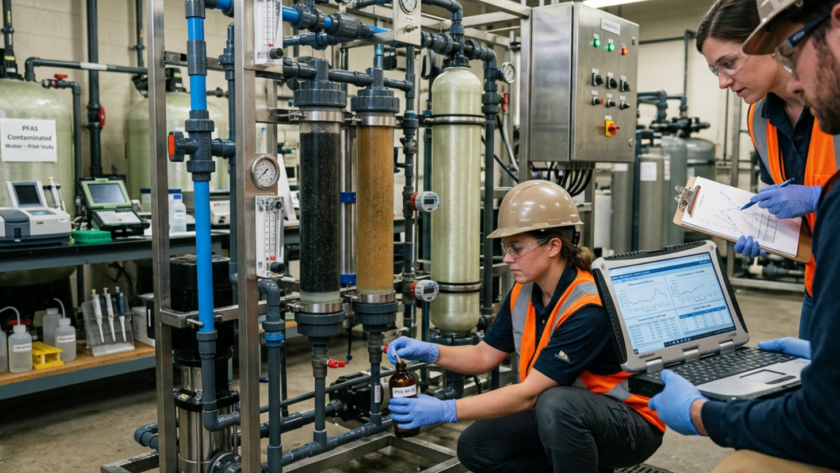
A significant advancement in water treatment technology is emerging from Flinders University, where researchers have developed a next-generation filtration system capable of removing up to 98% of toxic PFAS contaminants from water.
For industry leaders in environmental technology, utilities, and infrastructure, this…
The window for water utilities to secure their portion of the landmark 14 billion dollar PFAS settlement is narrowing. For leadership in the utility and infrastructure sectors, 2026 represents a definitive deadline for capital recovery. This settlement, linked to the AFFF Multidistrict Litigation involving 3M and DuPont, is one of the largest environmental payouts in…
The regulation of per- and polyfluoroalkyl substances (PFAS), the notorious “forever chemicals,” has reached a critical enforcement phase in 2026. As federal standards undergo recalibration, individual states have stepped in to fill the gap with aggressive product bans, mandatory testing, and massive cleanup funding.
A Rapid Expansion of PFAS Laws Across the U.S.
In 2026,…
As federal regulators tighten the net on “forever chemicals,” state-level legislation is beginning to provide the granular roadmaps industries need to manage their supply chains. Introduced on February 6, 2026, Maryland’s Senate Bill 686 (PFAS Chemicals – Product Phase Outs and Registration Requirements) represents a shift toward a more structured, registration-based compliance model.
For the…
For the past three years, the industrial sector has operated under a cloud of PFAS uncertainty. However, the first week of March 2026 has provided the “regulatory floor” the C-suite has been waiting for. Between the European Chemicals Agency (ECHA) finalizing its scientific risk opinions and the commercialization of 99.9999% destruction technologies, the path forward…
ZURICH — In a move that signals a paradigm shift for industrial wastewater management, Swiss cleantech firm Oxyle has announced the closing of a $16 million funding round. The investment is earmarked to scale what is currently the world’s only economical and permanent solution for destroying per- and polyfluoroalkyl substances (PFAS), commonly known as “forever…
In January 2026, the European Commission released a report that fundamentally reframes the global conversation on environmental risk. By estimating that remediation of PFAS-commonly known as “forever chemicals”-could cost up to €1.5 trillion, Europe has transformed PFAS pollution from a regulatory issue into a systemic economic threat.
For C-level leaders across manufacturing, chemicals, infrastructure, energy,…
Electron Beam Technology Signals a Breakthrough Moment in the Global Fight Against PFAS Pollution
In January 2026, a powerful new signal emerged in the global effort to eliminate PFAS-commonly known as “forever chemicals.” Researchers at Germany’s Helmholtz-Zentrum Berlin (HZB) demonstrated that electron beam technology for PFAS cleanup can move beyond containment and toward permanent chemical…
Executive Brief
France has become one of the first major European economies to formally prohibit the use of so-called “forever chemicals” in consumer products. As of today, the country’s ban on per- and polyfluoroalkyl substances (PFAS) is legally in force, marking a decisive shift in how governments balance industrial utility against long-term public health and…
As regulatory pressure on per- and polyfluoroalkyl substances (PFAS) intensifies worldwide, industrial leaders are confronting a hard truth: traditional PFAS treatment methods are no longer sufficient. In 2026, the market is moving decisively away from “capture and contain” strategies toward verified, commercial-scale PFAS destruction.
For executives responsible for environmental compliance, operational risk, and long-term capital…
A research team led by Rice University, in collaboration with international partners, has developed the first environmentally sustainable technology capable of rapidly capturing and breaking down PFAS in water. The findings, recently published in Advanced Materials, mark a significant advance against one of the most persistent environmental threats facing governments, utilities, and industry.
The work…