
China is accelerating its energy infrastructure transformation with a $1 billion investment in robotics aimed at modernizing power grid inspection and maintenance operations. The initiative underscores a strategic shift toward automation, artificial intelligence, and intelligent infrastructure management at national scale.
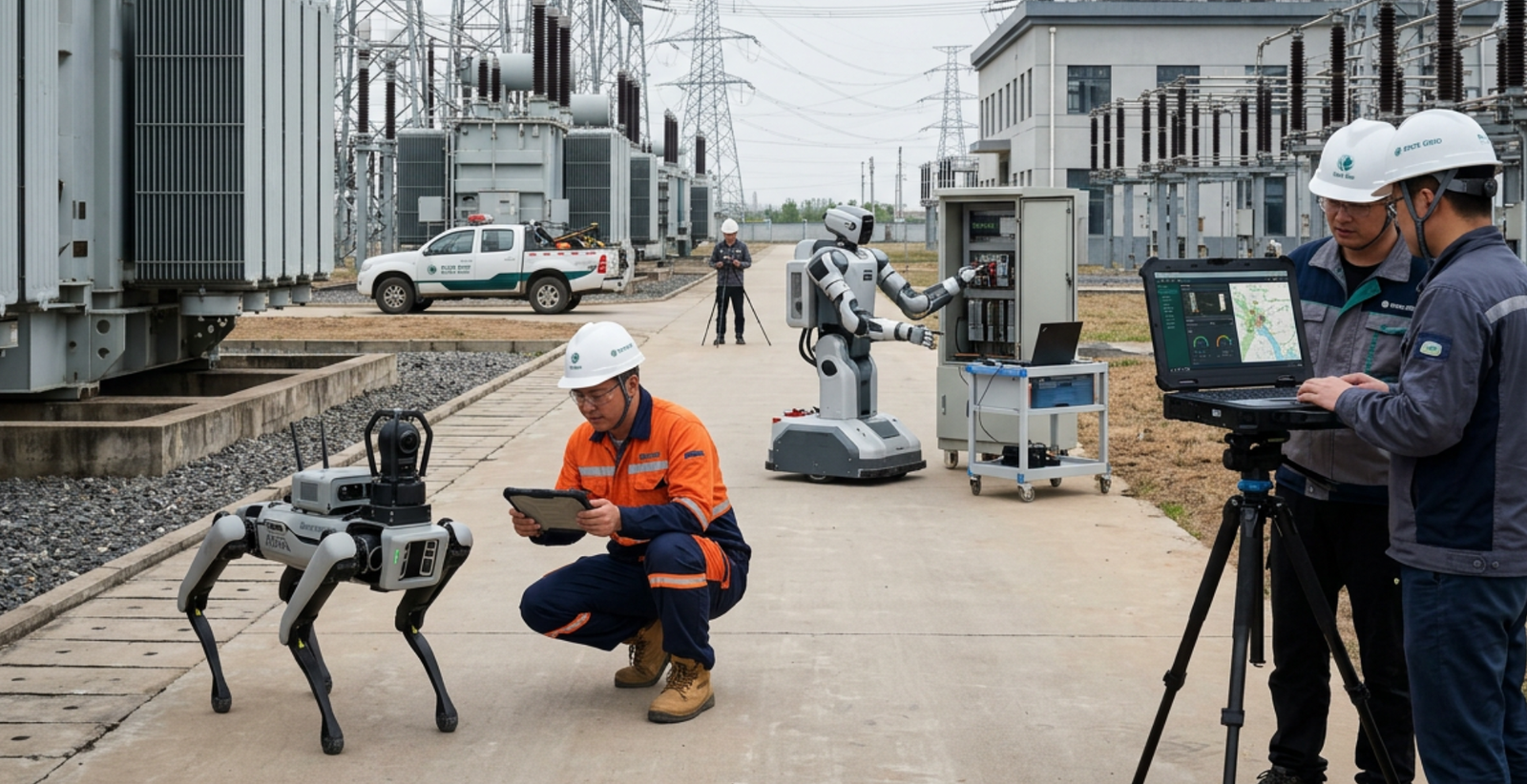
The investment, led by the State Grid Corporation of China, will deploy approximately 8,500 AI-enabled robotic systems across the country’s electricity network.
Automation at the Core of Grid Modernization
The China power grid robotics investment reflects a broader transition from manual infrastructure maintenance to autonomous, AI-driven systems.
The deployment includes:
- Around 5,000 robotic dogs for inspection of substations and transmission lines
- Humanoid and dual-arm robots for high-precision maintenance tasks
- AI-powered systems designed for remote and high-risk environments
These technologies are intended to enhance operational efficiency, reduce human risk exposure, and improve real-time monitoring of critical infrastructure.
Strengthening Ultra-High-Voltage Grid Operations
A key focus of the initiative is support for China’s expanding ultra-high-voltage (UHV) transmission network. These systems require continuous monitoring and maintenance across vast and often geographically challenging regions.
Robotics is expected to play a central role in:
- Inspecting remote and mountainous infrastructure
- Performing high-risk maintenance activities
- Improving system reliability and fault detection speed
For C-level executives, this represents a shift toward infrastructure systems that are not only digitized but increasingly autonomous.
Strategic Investment in Energy Intelligence
Beyond hardware deployment, the initiative signals a deeper strategic intent: embedding intelligence into national energy systems.
By integrating robotics with AI-driven monitoring platforms, China is effectively creating a self-monitoring and partially self-maintaining grid architecture.
This approach aligns with global trends where energy infrastructure is becoming:
- Data-driven
- Predictive rather than reactive
- Highly automated
Contrasting Global Infrastructure Approaches
The China power grid robotics investment highlights a widening gap in infrastructure modernization strategies globally.
While China is investing heavily in automation and robotics, other regions continue to face challenges related to aging grid infrastructure, capacity constraints, and slow modernization cycles.
This divergence is particularly significant in the context of rising electricity demand driven by:
- Artificial intelligence workloads
- Data center expansion
- Large-scale electrification
For decision-makers, the contrast underscores a growing strategic imperative: infrastructure modernization is becoming a determinant of economic competitiveness.
Implications for Global Energy Systems
The adoption of robotics in power grid management introduces several long-term implications:
- Operational Efficiency: Reduced maintenance downtime and faster fault resolution
- Workforce Transformation: Shift from manual inspection to digital supervision
- Infrastructure Resilience: Improved reliability in extreme or remote environments
- Scalability: Ability to manage rapidly expanding energy networks
These factors collectively point toward a future where energy systems are increasingly autonomous and software-defined.
Conclusion: The Rise of Autonomous Energy Infrastructure
China’s $1 billion investment in robotics for power grid operations marks a significant milestone in the evolution of global energy infrastructure.
For C-level leaders, the development signals a clear direction of travel: the future of energy systems will be defined not only by capacity expansion, but by automation, intelligence, and real-time operational control.
As electricity demand continues to rise globally, countries that successfully integrate robotics and AI into their infrastructure will gain a decisive competitive advantage in energy reliability and economic growth.
The post China Deploys $1 Billion Robotics Investment to Modernize Power Grid Operations appeared first on Grid Modernization Xchange 2026.