
From Expansion to Optimization
The global EV ecosystem is entering a new phase.
The early challenge-building enough charging stations-is rapidly being replaced by a more complex mandate:
delivering fast, reliable, and universally accessible charging infrastructure at scale.
In 2026, EV charging is no longer just about adding capacity. It is about optimizing the entire user experience, and this shift carries significant implications for automakers, energy companies, and infrastructure investors worldwide.
Three Structural Shifts Defining EV Charging
1. Network Access Is Becoming Borderless
One of the most significant developments is the opening of proprietary charging networks.
Tesla, long known for its exclusive Supercharger ecosystem, is now enabling access to other automakers through the adoption of the North American Charging Standard (NACS).
Major OEMs-including Ford Motor Company, General Motors, Rivian, Volvo Cars, Mercedes-Benz, Hyundai Motor Company, and Kia Corporation-are aligning with this standard.
Strategic implication:
- Charging networks are evolving into shared infrastructure platforms
- Brand-specific ecosystems are giving way to interoperability and scale
- Drivers gain access to thousands of additional high-speed charging points
This marks a foundational shift toward a more unified global charging architecture.
2. Charging Speed Is Becoming a Competitive Differentiator
Next-generation EV platforms are pushing the limits of fast-charging capability.
Advancements include:
- Ultra-fast charging architectures
- Improved battery chemistries
- Enhanced thermal management systems
Even marginal gains-such as reducing charging time from 30 minutes to 20 minutes-translate into significant improvements in user experience and fleet efficiency.
Strategic implication:
- Charging speed is emerging as a core product differentiator
- Faster turnaround times improve asset utilization for fleets and logistics players
- Consumer adoption barriers-especially for long-distance travel-continue to decline
3. Reliability Is Now the Industry Battleground
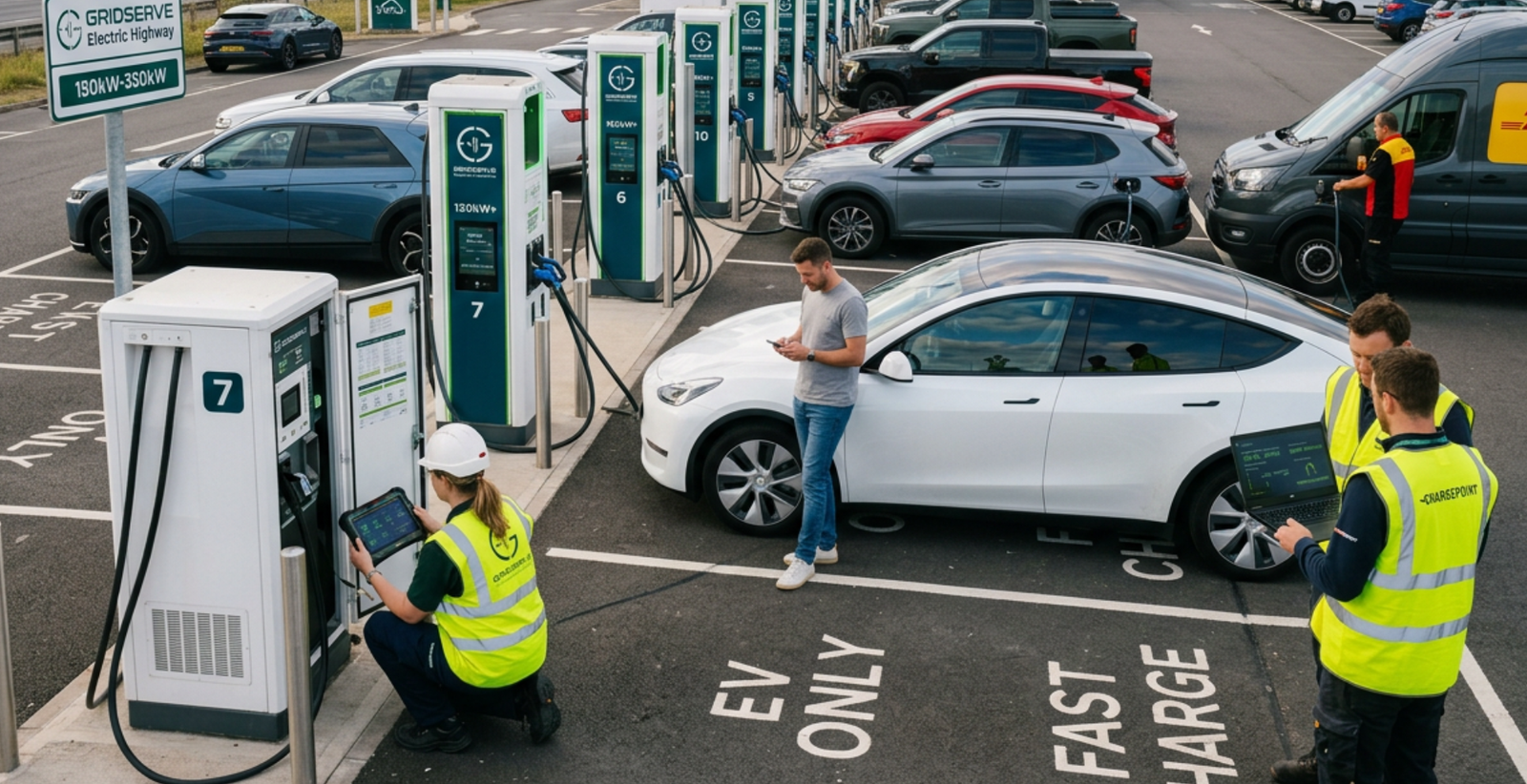
The next phase of infrastructure development is focused on operational excellence.
Charging networks are investing in:
- Real-time performance monitoring
- Predictive maintenance systems
- Multi-charger station designs
- Integrated outage detection
Simultaneously, automakers are embedding real-time charger availability into vehicle navigation systems.
Strategic implication:
- Reliability is becoming a brand-defining metric
- Data integration is critical for seamless user experience
- Infrastructure uptime directly impacts customer trust and adoption rates
Global Impact: A New Energy Infrastructure Paradigm
These shifts extend far beyond convenience-they are reshaping the global energy and mobility landscape.
Key global consequences:
- Acceleration of EV adoption across developed and emerging markets
- Convergence of automotive and energy sectors
- Massive capital flows into charging infrastructure and grid upgrades
- Standardization battles influencing global technology alignment
As interoperability improves, charging infrastructure begins to resemble traditional fuel networks-ubiquitous, reliable, and brand-agnostic.
What This Means for Emerging Markets Like India
For markets such as India, these global developments carry direct implications:
- Opportunity to leapfrog legacy charging models
- Increased pressure to adopt global standards and interoperability frameworks
- Need for robust public-private partnerships to scale infrastructure
- Alignment with global OEM strategies entering the Indian EV market
India’s charging ecosystem must evolve in parallel to remain competitive in the global EV transition.
Executive Insight: Strategic Priorities for Leaders
For C-suite executives across mobility, energy, and infrastructure sectors:
- Invest in interoperable charging ecosystems rather than closed networks
- Prioritize reliability and uptime metrics as core KPIs
- Align product strategy with fast-charging capabilities
- Leverage data integration for enhanced user experience
- Anticipate convergence between energy, software, and mobility platforms
Conclusion: From Innovation to Normalization
The most important shift in EV charging is not technological-it is behavioural.
Charging is transitioning from an experimental inconvenience to a routine expectation.
And that transformation is critical.
The post EV Charging in 2026: The Infrastructure Shift Reshaping Global Mobility appeared first on EV Charging Infrastructure Xchange 2026.